АТОМИК
You have the night shift. One operator, a control room, and a grid that expects its megawatts whether or not the plant is cooperating.
THE SHIFT
Hold the core steady. Answer the dispatcher. Decide which of the two failures your single repair crew attends to — because the other one is getting worse while you decide.
ATOMIC is built on a real reactor model rather than a difficulty slider. Xenon poisoning that makes a core fight you after a power drop. A positive void coefficient, the flaw that mattered. Steam-drum dynamics that make output a two-stage problem. Station auxiliaries that mean cooling costs you the very megawatts you are graded on. Nothing is a stat behind a menu; every control moves something physical.
WHAT A NIGHT LOOKS LIKE
FOUR POSTINGS
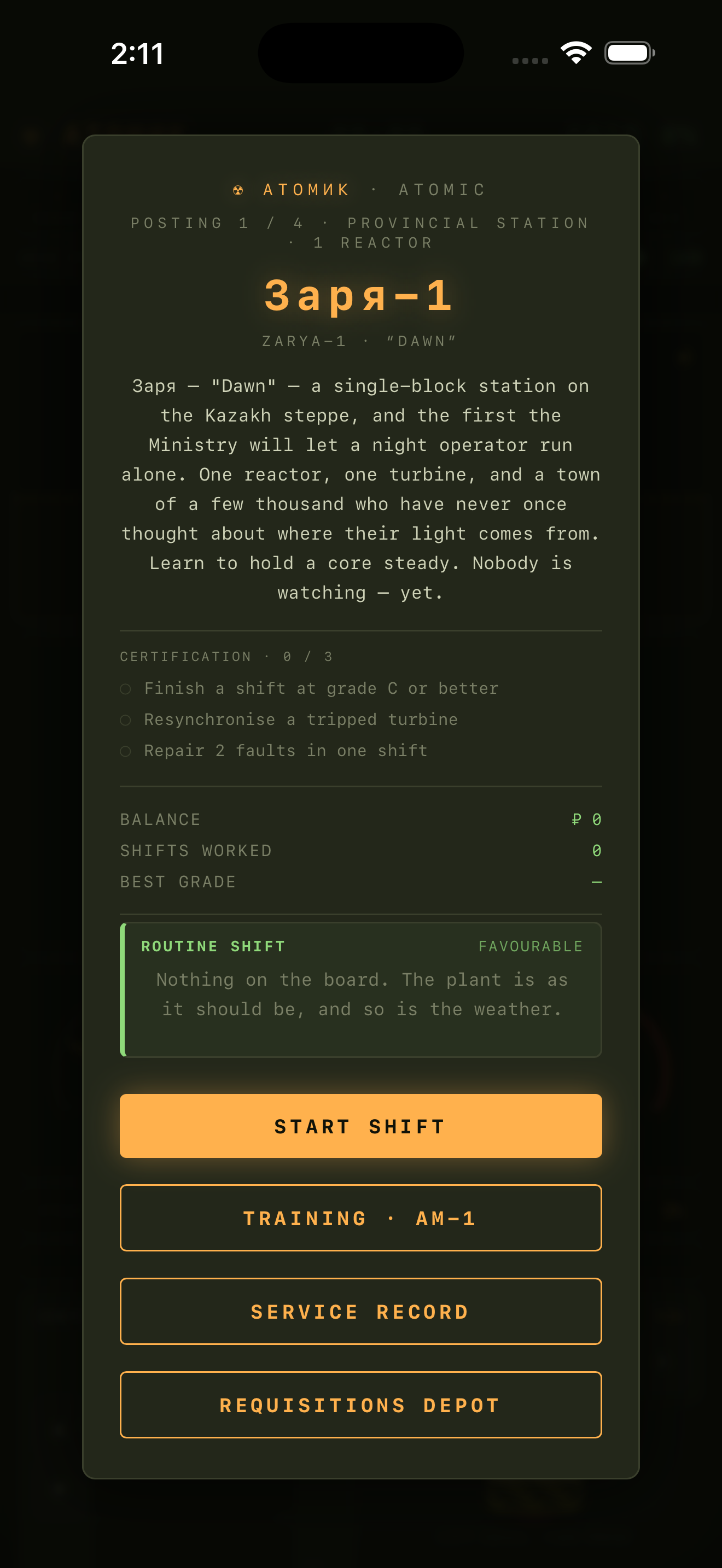
From a single-block provincial station on the Kazakh steppe to a four-reactor plant on the night of the safety test.
FAULTS THAT ROT
Ignore a fault and it degrades — then takes a neighbour down with it. Triage is about what a failure will become, not what it costs now.
CONDITIONS
Hard frost with the whole oblast's heaters on. A man from Moscow with a clipboard. Half the brigade out with flu. Announced before you commit.
REAL DILEMMAS
Dispatcher calls where both answers cost something. Refusing the rundown test is the safe call — and it costs you the certification.
AN ASSISTANT
Post a junior to one reactor so you can watch the others. They are slower than you, and they tire as the night goes on.
АЗ-5 IS NOT A PANIC BUTTON
The emergency shutdown inserts graphite before absorber. On a voided core it makes things worse. The game warns you. It does not stop you.
SCREENS
ON THE SUBJECT
The accident on 26 April 1986 was not inevitable. It came from a reactor with a known flaw, a test run past the point where it should have been stopped, and a culture where saying no was expensive. The game ends there, soberly, and says so plainly.